
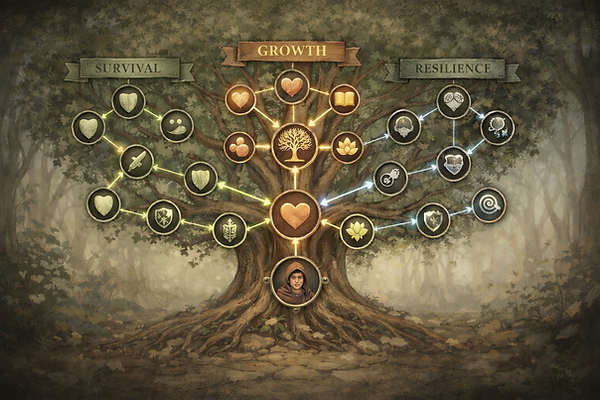
What is a Skill Tree?
In many video games, a skill tree is how a character grows. You don’t start with everything unlocked. You gain experience, invest points, and choose which skills to develop based on what helps you survive, explore, or take on tougher levels. Some abilities are chosen on purpose. Others are learned out of necessity—because the game got hard.
Life works a lot like that.
Many of the skills people bring into therapy— such as feeling guarded or feeling like you are on high alert—weren’t random. They were early upgrades that helped you get through difficult chapters. They may have worked then,. but now you might be realizing that the build that kept you alive isn’t the one you want to keep playing forever.
Therapy can be a place to open the skill tree and actually look at what you’ve unlocked.
Together, we slow things down and get curious about the skills you’ve developed, how your nervous system learned to respond, and what’s still serving you versus what’s costing you energy, connection, or peace. From there, we can intentionally invest in new skills—like regulation, boundaries, self-trust, flexibility, and self-compassion—at a pace that feels safe and sustainable.
There’s no “wrong build.” No reset button required. Just choice.
In therapy, mistakes are not failures—they're experience., and with the right support, you can decide where your next skill point goes.
About Nicole

MA - Counselling Psychology- Yorkville University 2026
BA - Psychology- Concordia University of Edmonton 2017
Trainings:
Brainspotting phase 1 - 2026
Nonviolent Crisis Intervention- 2025
CTA Clinical Practice Tools - 2016
Introduction to the Neurosequential Model of Core Concepts - 2016
Truth and Reconciliation- 2016
Cultural Diversity: Becoming an Ally- 2016
LEGO Social Skills Facilitator- 2011
I’m a Registered Psychotherapist (Qualifying) with a Master’s in Counselling Psychology and a Bachelor’s in Psychology, and I’ve spent about 15 years working in mental health. Along the way, I’ve supported neurodivergent individuals, couples, and people facing burnout, stress, and disconnection. I work under clinical supervision and draw from CBT, existential, and somatic approaches, always through a trauma-informed lens and with attention to how the nervous system shapes our thoughts, emotions, and relationships.
My work is grounded in respect, collaboration, and pacing therapy in a way that feels safe and manageable. We go at your speed. Together, we focus on building skills that feel realistic and sustainable—whether that’s learning to regulate, communicate more clearly, set boundaries, or simply understand yourself with more compassion.
When you sit across from me, my first priority is helping you feel truly heard and understood. I listen with curiosity, without judgment, and I take your lived experience seriously. I’m here to help you make sense of what you’ve been navigating, explore why certain patterns or survival strategies developed, and figure out what might actually support you now.